

Annual Financial Report
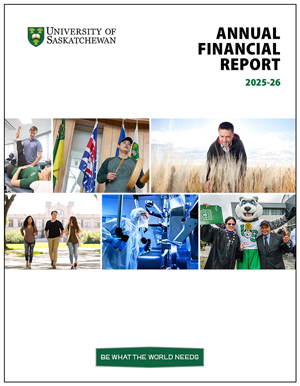
The Annual Financial Report is prepared by the Strategic Finance Office, under the coordination of the University Controller and the oversight of the Chief Financial Officer. It includes the audited financial statements for the fiscal year ending April 30, prepared in accordance with Canadian Generally Accepted Accounting Principles (GAAP). These statements provide a fair and accurate representation of the university’s financial position, operational performance, and changes in fund balances.
Accompanying the audited statements, the report outlines key financial outcomes, highlights notable achievements and challenges, and analyzes revenue and expense trends. It also includes disclosures aligned with the Canadian Sustainability Disclosure Standards and discusses the university’s approach to enterprise risk management.
2025-26 Annual Financial Report highlights

In the 2025-26 fiscal year, USask delivered strong financial results while continuing to advance our teaching, research, and service mission, despite the challenges faced by the post-secondary sector in the 2025-26 fiscal year, including declining international enrolment, evolving government funding arrangements, and broader global economic pressures.
Our results reflect strong domestic enrolment, growing research activities, continued donor support to deliver on our mission, and the combined efforts across all areas to manage expenses within our economic realities.
The university finished the year with an operating fund surplus of $10.9 million and a comprehensive surplus of $182.4 million. These results include extraordinary investment returns of 17.4 per cent or $197 million overall. Investment income mainly improves our restricted endowed funds, which have an increased annual spend this year of 27 per cent as USask shifted from 3.75% annual spending rate to 4.75 per cent. However, the investment income also provided unrestricted operating fund income of $20 million over budget that will support UPlan 2035 investments.
Further contributing to these strong results were prudent cost management measures implemented across the institution, such as vacancy management and attrition in select areas translated into meaningful salary and benefit savings.
Earlier in the year, long-term projections indicated potential operating deficits if spending patterns continued and the next multi-year funding agreement did not include inflationary support. In response, university leaders took steps to carefully manage hiring, control costs, and grow alternative revenues. Combined with the province's new four-year funding agreement, which provides annual operating grant increases of three per cent per year to 2030, these actions have significantly strengthened USask's financial outlook. The operating budget is now structurally balanced, with strategic investment opportunities and balanced projections through 2030.
While international enrolment declines continue to create revenue pressures in some areas, USask has targeted financial support to affected colleges and schools, and the university has maintained financial stability without broad layoffs. With our improved financial position, USask has also been able to make strategic one-time investments in several priorities, such as systems renewal, capital infrastructure, equipment renewal, and seed start-up funds for future investments supporting recruitment.
Looking ahead and with the launch of USask’s UPlan 2035, USask will continue to make key investments to advance our strategy. This includes continuing to manage a structurally balanced operating fund while leveraging our financial strength to raise up to $250 million in new financing to support our enterprise systems, expand student learning spaces, and invest in alternative revenue generation initiatives aligned with our mission, such as expanding cyclotron facilities supporting nuclear medicine innovations.
USask has faced financial challenges many times in the past, each time with resiliency, and is now in a position of strength. Having Canada’s largest research infrastructures to support vaccine development, advanced materials testing, nuclear medicine, water and food security, animal and plant health and genomics, and more. USask is poised to serve local community needs, deliver on provincial and national priorities, and address global issues.
Sincerely,
Deidre (Dee) Henne
Chief Financial Officer
University of Saskatchewan
Messages
Chair, Board of Governors
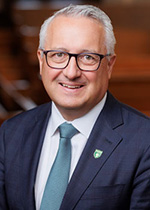
Despite a challenging economic environment across the post-secondary sector, I'm pleased to report on behalf of the Board of Governors that the University of Saskatchewan (USask) is moving forward with financial strength, stability, and momentum.
I also want to acknowledge Dr. Peter Stoicheff, whose ten-year term as president concluded on Dec. 31, 2026. His steady leadership helped build the strong foundation USask stands on today, and on behalf of the Board, I thank him for his years of service.
The Board was pleased to welcome Dr. Vince Bruni-Bossio as the university's 12th president on Jan. 1, 2026. He has hit the ground running, quickly building relationships across our campuses and with the provincial government, and his early leadership has already helped position USask well for the year ahead.
On Nov. 3, the provincial government announced a new four-year funding agreement providing a three per cent annual increase to operating grants, offering welcome financial certainty. Combined with strong investment income and prudent financial management, this helped USask finish 2025-26 with an operating fund surplus — a result reflecting both Peter's steady stewardship through the transition and the momentum now building under President Bruni-Bossio.
Looking to 2026/27, USask is well-positioned to navigate ongoing challenges, from international student limits to trade pressures and global uncertainty. We remain focused on strengthening provincial, national and international collaboration, deepening ties with industry and academic partners, and investing in strategic priorities that build a stronger financial outlook for the university and the province.
Together, we will continue enhancing the education USask provides, meeting the needs of the people of Saskatchewan while delivering impact nationally and around the world.
Keith Martell
Chair, Board of Governors
President and vice-chancellor

I want to start off by thanking the University of Saskatchewan (USask) community for its commitment, work, and support over the past year. As global challenges such as climate change, technological disruption, geopolitical instability, and widening inequities reshape the environment in which universities operate, USask continues to meet these challenges with clarity and purpose.
Our ability to respond to these challenges is rooted in USask’s history, where periods of uncertainty have been met with resilience, flexibility, and a willingness to adapt. These qualities continue to guide us as we navigate new circumstances and opportunities while remaining steadfast in our commitment to our mission and the communities we serve. Across Canada, universities are facing shifting federal policies, evolving expectations, and global uncertainty. USask has felt these impacts directly, and our community has shown renewed dedication to serving Saskatchewan and the world.
As a result, USask is effectively managing a changing policy environment that has created financial uncertainty across the sector. Federal policy changes related to international study permits have reduced tuition revenues by approximately $24 million over two years, with further pressures expected. We have developed comprehensive strategies to manage these impacts and are confident in our approach to this sector-wide issue.
At the same time, the stable and predictable provincial funding that comes with the new four year Memorandum of Understanding (MOU2) helps mitigate some of the effects created by federal policy changes. The MOU2 introduces an Accountability Framework that sets clear goals for student success, economic contribution, and long term financial sustainability. These realities require ongoing adaptation, careful planning, and new approaches to revenue diversification and cost management. The institution has responded by strengthening partnerships with industry, pursuing alternative revenue generation projects, and directing investments to areas most affected by federal policy changes to maintain program quality.
This environment underscores the importance of the next strategic plan, University Plan 2035. The plan is being shaped through broad engagement with students, faculty, staff, alumni, donors, industry, government, and community leaders. A clear theme emerging from these conversations is the idea of local to global. Saskatchewan’s context provides unique advantages in addressing global challenges, and institutes and facilities across campus continue to demonstrate how local expertise can shape global solutions.
As planning continues, the focus is on building an institution that is innovative, collaborative, and prepared for the challenges ahead. Thank you for your continued support and for the confidence you place in this institution. Together, we are moving forward together to shape a future where USask remains a source of strength for Saskatchewan and a contributor to solutions the world needs.
Vince Bruni-Bossio
President and vice-chancellor
Previous reports
Contact
Controller’s Office
University of Saskatchewan
Administration Building, Room E180
Saskatoon, SK, S7N 5A2
Tel: (306) 966-1970